Articles

Articles & Insights

Discover, learn, and grow with stories from our ecosystem members.

search
filter_list Category: finance-wealth
close
Building AI Infrastructure That Scales From Cloud To Edge Finance & Wealth
Oct 16, 2026 • visibility 7 • 14 min read

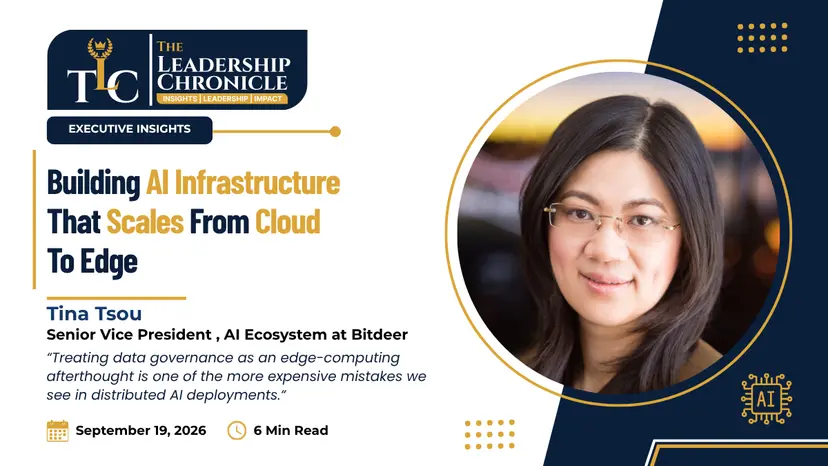
Building AI Infrastructure That Scales From Cloud To Edge

Open Interfaces Security and Operations for Distributed AI PlatformsAI infrastructure is becoming a distributed systems problem. Training may take place in a high-performance computing environment, inference may run in a public or private cloud, and time-sensitive decisions may need to happen on a factory floor, in a vehicle, or at a remote site. The value of the system depends on how well these environments work together.Organizations should approach this as one platform spanning a continuum of locations rather than as a collection of isolated AI projects. That platform needs clear workload-placement rules, open interfaces, a security model that reaches every node, and operational practices that cover models, data, policies, and infrastructure together. These choices determine whether an early pilot can become a service that the organization can operate at scale.Workload Placement Comes FirstThe first architecture decision is where each workload should run. Cloud and centralized data centers offer large pools of compute, mature services, and efficient access to shared data. Edge locations can reduce latency, limit the movement of sensitive data, conserve bandwidth, and preserve local operation when connectivity is constrained. The right answer is usually a combination, with placement based on the needs of each workload.A practical placement review should examine latency, data sensitivity, compute and energy requirements, network reliability, and the cost of operating the workload over its full life. It should also consider how quickly models and policies must be updated. A workload that performs well in a laboratory can become expensive or fragile when it is distributed across thousands of sites without a reliable update and rollback process.This review should happen before a team commits to a platform. Product selection can then follow the architecture instead of defining it. That sequence preserves room to use specialized accelerators, local data services, or cloud capabilities when they create a measurable advantage.“Sequencing architecture before product selection sounds obvious until you watch how many organizations do it backward — buying the platform first and discovering the constraints later.”Open Interfaces Reduce Operational FrictionDistributed AI environments are heterogeneous by design. They include different processors, accelerators, operating systems, runtimes, networks, and management domains. Requiring every location to use the same hardware or software stack creates a brittle form of consistency. A more durable approach standardizes the interfaces between layers while allowing implementation choices beneath them.Open APIs, declarative workload definitions, portable packaging, and common telemetry formats give operators a stable way to deploy and observe services across varied environments. LF Edge, for example, describes an open framework that is independent of hardware, silicon, cloud, and operating system. OpenTelemetry provides vendor-neutral instrumentation for traces, metrics, and logs. These efforts show how common interfaces can reduce integration work without requiring one vendor to supply every component.Open source contributes reference implementations, shared testing, and a place for multiple companies to solve common problems together. It still requires disciplined governance. Enterprises need a supported bill of materials, clear ownership, tested upgrade paths, and a process for managing vulnerabilities. The goal is controlled choice, not uncontrolled variation.“Controlled choice, not uncontrolled variation” is a distinction worth pinning above every platform team’s desk.”Security Must Span the Full Deployment ContinuumSecurity cannot stop at the cloud boundary. Every device, workload, model artifact, data flow, and management service needs an identity that can be verified. Access should be limited by policy, software and model artifacts should be signed, data should be protected in transit and at rest, and remote systems should be able to prove relevant aspects of their state before receiving sensitive workloads or data.Remote attestation is useful because it turns trust into an evidence-based decision. The IETF Remote ATtestation procedureS architecture defines roles for producing, evaluating, and using evidence about a system’s operating state. The architecture is intentionally neutral about processors and protocols, which makes it relevant to heterogeneous AI deployments. Attestation does not eliminate risk, but it can give a relying party a consistent way to evaluate whether a remote system meets policy before establishing trust.The same discipline should apply to AI risk. The NIST AI Risk Management Framework encourages organizations to govern, map, measure, and manage risk throughout the AI lifecycle. CISA’s Secure by Design guidance places responsibility on technology producers to make safe outcomes easier for customers. Together, these ideas support a clear operating principle: security requirements should shape architecture, product defaults, and lifecycle processes from the beginning.Data governance is part of that security model. Teams need to know where data originated, what uses are permitted, where it may travel, how long it may be retained, and which model or decision used it. At the edge, local processing can reduce unnecessary data movement, but it also creates more locations that must be inventoried, monitored, and governed.“Treating data governance as an edge-computing afterthought is one of the more expensive mistakes we see in distributed AI deployments. This piece treats it as inseparable from security from the outset.”Models Need Operational DisciplineA deployed model is a living system. Its inputs change, its performance can drift, dependencies are patched, and business policies evolve. Operating the model therefore requires more than a one-time deployment. The organization needs a repeatable lifecycle for testing, approval, rollout, monitoring, incident response, and retirement.The deployment record should connect the model version with its configuration, runtime, policy set, and approved use. Changes should move through staged environments, and operators should be able to pause or roll back a release when results fall outside defined limits. At the edge, those controls must continue to work across intermittent networks and large fleets of devices.Observability should follow the request across cloud and edge boundaries. Infrastructure metrics alone cannot explain whether an AI service is meeting its purpose. Teams also need signals tied to model quality, response time, resource consumption, policy violations, and human escalation. A shared telemetry model makes it easier to compare behavior across locations and to investigate failures that cross organizational or vendor boundaries.Interoperability Is a Business DecisionInteroperability is often treated as a technical preference, but it has direct business consequences. It affects how quickly a company can add a new hardware platform, move a workload, work with an ecosystem partner, or replace a component that no longer meets requirements. It also influences negotiating leverage and the long-term cost of change.Executives should ask for portability at the points where switching costs are highest. Workload packages should move without a complete rebuild. Telemetry should remain available when an observability backend changes. Identity and policy should work across locations. Data should be exportable with its meaning and lineage intact. Procurement terms should reinforce these architecture goals by addressing interfaces, data access, operational visibility, and exit paths.Interoperability does not mean that every component is interchangeable. Specialized systems can deliver important gains. The organization should know where it is accepting a dependency, why the advantage justifies it, and how the surrounding architecture limits the cost of that choice.The Executive AgendaLeadership teams can make the architecture concrete through five actions.Classify workloads. Define placement criteria for latency, data sensitivity, compute demand, connectivity, resilience, and lifecycle cost. Review each use case against those criteria before selecting a platform.Set interface requirements. Specify the APIs, packaging formats, identity mechanisms, telemetry, and data contracts that must remain portable across the deployment continuum.Make trust verifiable. Use strong identity, signed artifacts, least-privilege access, remote attestation where appropriate, and policy enforcement that can operate at distributed locations.Manage the complete lifecycle. Connect model approval, deployment, monitoring, rollback, and retirement. Treat the runtime, configuration, and policy set as part of the deployed system.Test the exit path. Verify that workloads, data, telemetry, and operational records can move before the organization depends on a platform at scale. Portability that has never been tested is only an assumption.“Portability that has never been tested is only an assumption” is the single line from this piece worth forwarding to your infrastructure team today.”For more details, visit: https://theleadershipchronicle.com/If you would like to get featured or want to know more, connect with us at [email protected] : https://www.linkedin.com/company/the-leadership-chronicle/Twitter : @TLChronicle

No More Guessing Games: The FDA and EMA Just Wrote AI’s Rulebook Finance & Wealth
Oct 15, 2026 • visibility 8 • 10 min read

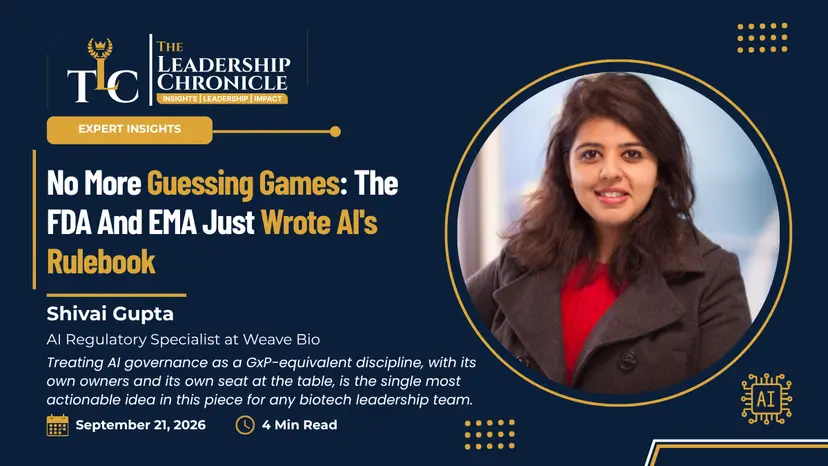
No More Guessing Games: The FDA and EMA Just Wrote AI’s Rulebook

Two years ago, a pharma sponsor asked the FDA a simple question: “Can we use AI to identify patients most likely to respond to our therapy?” The answer, in essence, was “it depends, and we’ll figure it out together.”That answer no longer holds. In the span of twelve months, the FDA and EMA have moved from case-by-case improvisation to the most significant AI framework in the history of modern clinical research. For sponsors, CROs, and biotech leadership, this isn’t a future consideration. It’s a compliance conversation happening right nowThe Regulatory Shift You Need to Know AboutTwo milestones define this new era.January 2025, FDA Draft Guidance. “Considerations for the Use of AI to Support Regulatory Decision-Making for Drug & Biological Products” introduced a seven-step, risk-based credibility framework for evaluating AI models used in submissions. This wasn’t written in a vacuum: the FDA has received more than 800 AI-component submissions since 2016. Nearly a decade of hands-on review experience is baked into this framework, which is exactly what makes it so different from the ad hoc guidance sponsors were navigating even two years ago.January 2026, FDA + EMA Joint Principles. The two agencies released ten Guiding Principles for Good AI Practice in Drug Development, the first coordinated transatlantic regulatory position on AI in pharma. For global sponsors, this is the end of trying to satisfy two separate regulatory philosophies with two separate strategies. There is now one shared standard to build toward.Having spent years working across CMC, digital biotech, and regulatory science, including time inside the FDA itself before moving into industry, I’ve watched this shift from both sides of the table. The agencies didn’t get more permissive. They got more precise. And precision is something sponsors can actually build a strategy around.“This is a rare case of regulators getting ahead of an industry’s growing pains instead of two years behind them. That alone should change how boards prioritize AI governance conversations.”What This Means For SponsorsHere’s the mindset shift that matters most: the sponsors who thrive in this new environment won’t be the ones with the most sophisticated models. They’ll be the ones who can explain those models clearly to a regulator, and stand behind every decision the model influenced.That’s a scientific communication problem as much as a technical one. Practically, it breaks down into five disciplines:1. Specify exactly how each AI model is used in your study. Vague descriptions of “AI-assisted analysis” no longer clear the bar. Regulators want to know the model’s role, inputs, and boundaries in your trial design.2. Identify, quantify, and mitigate risks to the trial. This means building a risk assessment into your protocol from day one, not retrofitting one after a question from reviewers.3. Validate continuously, not once. Models degrade as data environments shift, a phenomenon known as data drift. A model validated at trial start can behave differently eighteen months later if the underlying data population changes. Ongoing validation isn’t optional; it’s the new baseline expectation.4. Integrate data scientists with clinical leads throughout the trial, not as a handoff. The sponsors who struggle are the ones where data science and clinical operations work in sequence. The ones who succeed build those functions into one continuous conversation, from protocol design through database lock.5. Keep humans accountable. AI supports the decision. It does not make it. Every regulatory framework published in the last eighteen months reinforces this principle, and it’s the one non-negotiable that underlies all the others.“Notice that none of these five disciplines are technical in the AI-engineering sense. They read closer to what a regulatory affairs team already does — which suggests the real skill gap most sponsors need to close isn’t data science. It is translation.”The Big PictureWhat’s striking is just how far AI has already spread across the clinical trial lifecycle. It’s no longer confined to one function. It now shapes how trials are designed, how patients are recruited and matched to studies, how biomarker and real-world evidence data gets analyzed, how safety signals get caught early, and how manufacturing gets optimized. Each of these areas now comes with its own documentation and validation expectations under the new frameworks. That’s a lot of ground for a sponsor to cover, which is exactly why this has shifted from a “watch this space” conversation to a “build this into your operating model” conversation.Where This Leaves SponsorsThe good news buried in all this new structure is that ambiguity was never really an advantage for anyone. Sponsors spent the last several years trying to anticipate what regulators might ask. Now there’s a published, risk-based framework and a transatlantic set of shared principles to build against. That’s a foundation, not a hurdle.The organizations that get ahead from here will treat AI governance the way they already treat GxP compliance: as a discipline with its own owners, its own documentation trail, and its own seat at the leadership table, not a side project bolted onto data science.“Treating AI governance as a GxP-equivalent discipline, with its own owners and its own seat at the table, is the single most actionable idea in this piece for any biotech leadership team building next year’s org chart.”Having worked across the full arc of this problem, from bench immunology research, through CMC and regulatory affairs, to building AI adoption strategies for biotech and pharma teams today, my read is straightforward: the agencies have done sponsors a favor. They’ve replaced guesswork with a rulebook. The work now is execution.For more details, visit: https://theleadershipchronicle.com/If you would like to get featured or want to know more, connect with us at [email protected] : https://www.linkedin.com/company/the-leadership-chronicle/Twitter : @TLChronicle

From Zero to Scale: A Technical Program Manager’s Playbook for Building Engineering Teams Finance & Wealth
Oct 15, 2026 • visibility 7 • 12 min read

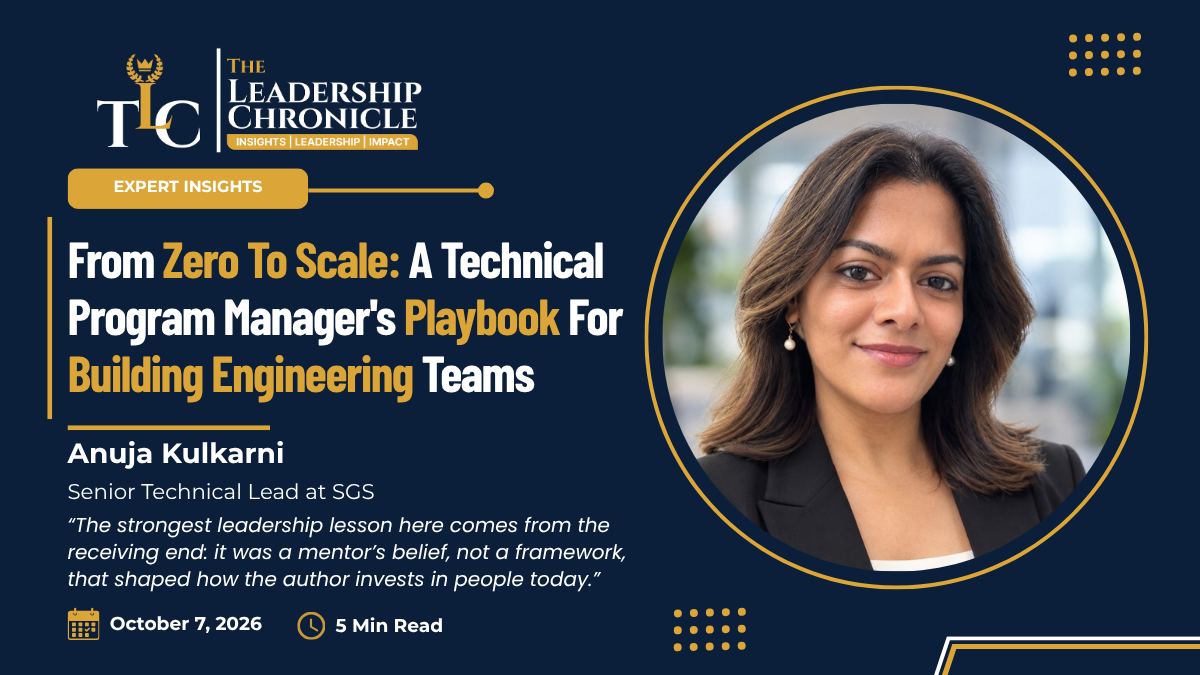
From Zero to Scale: A Technical Program Manager’s Playbook for Building Engineering Teams

Six principles for turning a handful of engineers into a high-performing organization, whatever industry you build in.Every engineering team starts small, with a mandate, a deadline and a few people who aren’t yet sure what “done” looks like. Whether it’s a fintech startup’s first platform squad, a medical-device company standing up a validation lab or an automaker building its first software division, the challenge is the same. Growth either strengthens the team or quietly breaks it.Technical program managers sit at the center of that transition. We rarely write the code or run the tests, but we shape the structures, rhythms and relationships that decide whether a team of five can become a team of fifty. Here is the playbook I have refined over more than a decade of building engineering teams.1. Start with a purpose, not a headcountWhen a new program lands, the first instinct is to ask for more people. Resist it. A small team with a sharp mission will outperform a larger one that is still debating what it’s for.I once launched an AT&T 5G field certification program with just four engineers, during the pandemic in 2020, when test sites were scarce and the standard itself didn’t exist yet. What carried us wasn’t headcount; it was clarity. Everyone knew what we had to prove and for whom. The framework we built became the industry’s entry criterion for 5G handset certification.The lesson: before you grow the team, make sure everyone on it can say, in their own words, why the work matters and who it helps.“Most scaling advice begins with hiring. This piece begins with purpose — a sequencing choice that explains how a four-person team could carry a difficult certification program before the standard itself existed.”2. Design roles around skills, not titlesIn a relatively new team everyone does everything, which feels agile until the first hard deadline. As the work grows, the TPM’s job is to break it into streams that run in parallel and match them to people’s strengths. Give junior engineers well-defined work with clear quality gates. Let senior engineers own the architecture, templates and hardest problems. Bring analysts in early so data isn’t an afterthought.Just as important is what the TPM doesn’t do. I don’t micromanage. Once the work is shaped, I let the leads take charge of their streams and hold them accountable for the outcome and for every step along the way. Spoon-feeding answers may feel faster, but it stops people from building the judgment a growing team depends on.Do this well and it does more than speed up delivery. It creates a growth ladder where people are stretched without being overwhelmed, and today’s juniors become tomorrow’s leads.3. Build the operating system before you need itWhat works for a team of five rarely works for fifteen. When know-how lives only in a few people’s heads, those people become bottlenecks as the team grows.Invest early in the unglamorous foundations such as onboarding guides, runbooks, a shared definition of “done,” standard templates and a decision log. None of it makes headlines, but it compounds. Each new hire becomes productive faster and strengthens the system instead of adding load to it.4. Protect the team from moving targetsAt Element, I stepped in mid-program when the original program manager left a vendor certification program for T-Mobile. We were coordinating twelve field engineers across six markets, with eight to ten test sites each. The acceptance criteria had never been formally documented, so new KPIs kept appearing and approved work kept being reopened. When the test markets changed mid-program, the team faced re-performing items that had already been signed off.Rather than absorb the churn, we documented a baseline, gave every requirement a traceable ID and moved work through staged gates that couldn’t slip backwards. The client adopted the structure, certification followed, and a tense relationship became a lasting partnership.The lesson: a TPM’s first duty to an engineering team is to absorb ambiguity so the engineers don’t have to.“Scope creep is usually discussed as a schedule risk. The author treats it as a people risk, and the fix — a documented baseline, traceable requirement IDs and gates that cannot slip backwards — is one any program lead can borrow this week.”5. Measure what matters, and make it visibleYou cannot scale what you cannot see. Choose a few metrics that reflect how the team actually delivers, such as cycle time, milestone adherence and defect escape rate, or deployment frequency and recovery time for software teams. Put them where everyone, from engineers to executives, can see them.Good metrics don’t police a team. They give it a shared version of the truth and let it fix problems before a customer finds them. This is where AI comes in these days. AI-assisted analytics can pull data from different tools, spot risks and trends early and turn raw results into clear reports in minutes rather than days. That frees the team to act on the numbers instead of spending hours compiling them.6. Let trust do the scalingScale is earned, not planned. A team that delivers consistently builds a reputation, the reputation brings in new work, and that work funds the next hire.The same logic applies inside the team. As it grows, the TPM has to shift from doing to enabling: delegating decisions, growing leads who own whole workstreams and stepping back from details that once needed them.I learned this from the other side. As a lead engineer, no one asked me to take charge or come up with new projects. But my director, a mentor in every sense, kept showing me what I couldn’t yet see in myself: that I could lead teams and shape a vision for the whole business unit. He saw me going places long before I did. That belief changed how I worked, and it is the biggest reason I invest in the people around me today.The lesson: great leaders don’t just delegate work; they help people see the leader they could become.“The strongest leadership lesson here comes from the receiving end: it was a mentor’s belief, not a framework, that shaped how the author invests in people today.”The TPM’s real jobWhen I look back, from mentoring my first junior engineers at BlackBerry to leading cross-regional teams today, the pattern is the same. Technical program managers don’t build teams by writing org charts. We build them by creating clarity, structure and trust, and then getting out of the way so talented engineers can do their best work.The metrics, certifications and revenue matter. But the measure I care about most is how many of the engineers I’ve worked with have gone on to lead teams of their own.As Albert Einstein put it: “Strive not to be a success, but rather to be of value.”For a technical program manager, that is the whole playbook in one line.For more details, visit: https://theleadershipchronicle.com/If you would like to get featured or want to know more, connect with us at [email protected] : https://www.linkedin.com/company/the-leadership-chronicle/Twitter : @TLChronicle

Who Is Acting In Your Enterprise Right Now? Finance & Wealth
Oct 15, 2026 • visibility 11 • 11 min read

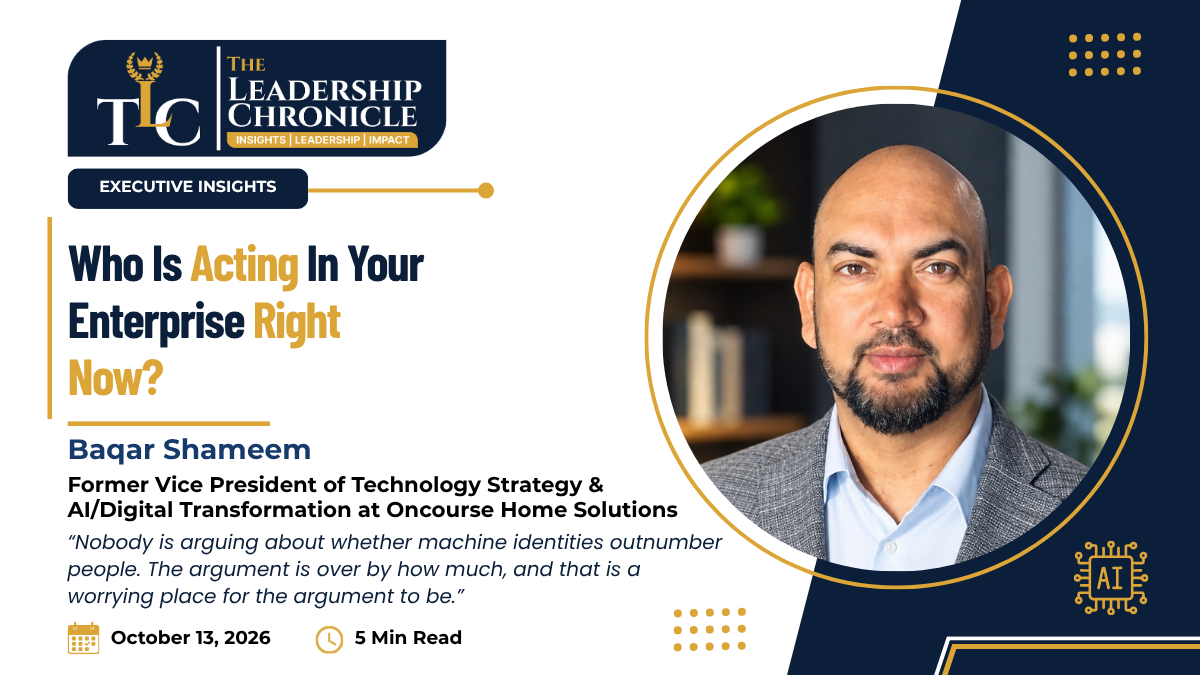
Who Is Acting In Your Enterprise Right Now?

People, machines and AI agents all hold keys to your systems. Most companies can only see one of the three.Ask a security team how many people can reach their billing system and you will get an answer by lunch. Ask how many software accounts, tokens and AI agents can reach it, and the room goes quiet.I know that quiet room well. It is an uncomfortable place for a technology leader, because the question is fair and the honest answer is “we would have to go and look.”Counting what nobody countedEvery company already runs on identities that never clock in. A deployment pipeline logs into the cloud. A reporting tool reads the customer database. A script written by someone who left in 2021 still refreshes a token every night. Security people call these non-human identities. Add the AI agents that teams are now wiring into email, code and finance systems, and the population gets large very quickly.How large depends on who is counting. According to public information, Veza, working from access data, puts it near 17 machine identities for every person. CyberArk has said more than 80. Palo Alto Networks reported 82 a year ago and 109 in its 2026 figures. The gap between 17 and 109 is wide, and I would not be willing to bet my budget on any single number. What every estimate agrees on is the direction, and that machines outnumber us by a wide margin.Nobody is arguing about whether machine identities outnumber people. The argument is over by how much, and that is a worrying place for the argument to be.Three doors, one patternThis year has handed us a few uncomfortable case studies. In February, researchers at Truffle Security reported that 2,863 publicly visible Google API keys had quietly gained access to Gemini. The keys had been created years earlier for something harmless like a map embed. Nobody changed them. Google changed what they could reach.In April, Vercel disclosed an incident that began with a broad OAuth permission granted to a third-party tool. The permission was reused further along than anyone intended. In July, a Hugging Face report described AI agents running an evaluation that ended up in production through credentials they should not have had.The three events share no vendor, no attacker and no technique. They share a gap. In each one, an identity held more access than its owner understood, and no single system could show the whole picture.“Three incidents, three different entry points, one gap. The author’s point is that identity risk rarely arrives as a single dramatic failure. It builds quietly, in access that nobody has reviewed.”Why your current tools miss itWorkforce identity tools were built for employees. They know when someone joins, changes teams or leaves. Cloud consoles know their own accounts. AI agents, in many shops, borrow a shared API key from whoever set them up. Each tool describes its own corner accurately and says nothing about the rest.The trouble shows up in the details. A service account can look harmless on its own and still sit three hops from your most sensitive data. An agent can inherit a person’s permissions and use them at three in the morning at machine speed. A key shared by a dozen workflows leaves a log that says the key did something, and nothing more.Take the same agent and ask the question an auditor will ask first: who sent it, and with what authority? With a shared key the honest reply is a shrug. With a governed identity the reply takes minutes.“Who sent it, and with what authority?” is the question to carry into your next security review. If the honest answer is a shrug, the problem is accountability before it is technology.What governing all identities means in practiceI do not think this needs a new philosophy. It needs the discipline we already apply to people, extended to everything else that holds a key. Four questions are a fair test of where a company stands.Who owns this identity today, by name?What can it actually reach, once every inherited and delegated permission is counted?When did it last use that access, and was anyone watching?If it were switched off this afternoon, what would stop working?If your team cannot answer all four for a human, a service account and an AI agent in the same afternoon, you have found the gap. Closing it will take a few firm habits:Give every non-human identity a named human owner and review that assignment on a schedule.Measure effective access, meaning what an identity can really reach, and ignore the access it was supposed to have.Replace long-lived shared keys with credentials that are scoped and expire.Treat an AI agent as a worker with a manager. Record who authorized it and what it did.An auditor will not ask how many identities you have. They will ask who is responsible for each one.Where this leaves leadersBoards are starting to ask about AI risk in general terms. The sharper question sits underneath it, and it is about identity. Who and what is acting inside our systems, with whose permission, and could we prove it tomorrow?“Most boards still frame AI risk as a model problem. This piece asks leaders to look one layer lower, at who and what holds the keys, because that is where an audit will start.”Companies that can answer will move faster on AI, because they will know what they are letting loose. Companies that cannot will spend 2027 explaining a breach that began with an account nobody remembered. I would rather my own organization be in the first group, and that is a good enough reason to start counting now.SourcesVeza, 2026 access data on machine-to-human identity ratios, as reported by ITWeb Africa (July 2026).CyberArk research on machine identity growth, as reported by ITWeb Africa (July 2026).Palo Alto Networks, 2025 and 2026 identity figures, as reported by ITWeb Africa (July 2026).Truffle Security research on Google API keys and Gemini access (February 2026), via NHI Management Group.Aembit breach tracker, entries on Vercel (April 2026) and Hugging Face (July 2026).For more details, visit: https://theleadershipchronicle.com/If you would like to get featured or want to know more, connect with us at [email protected] : https://www.linkedin.com/company/the-leadership-chronicle/Twitter : @TLChronicle

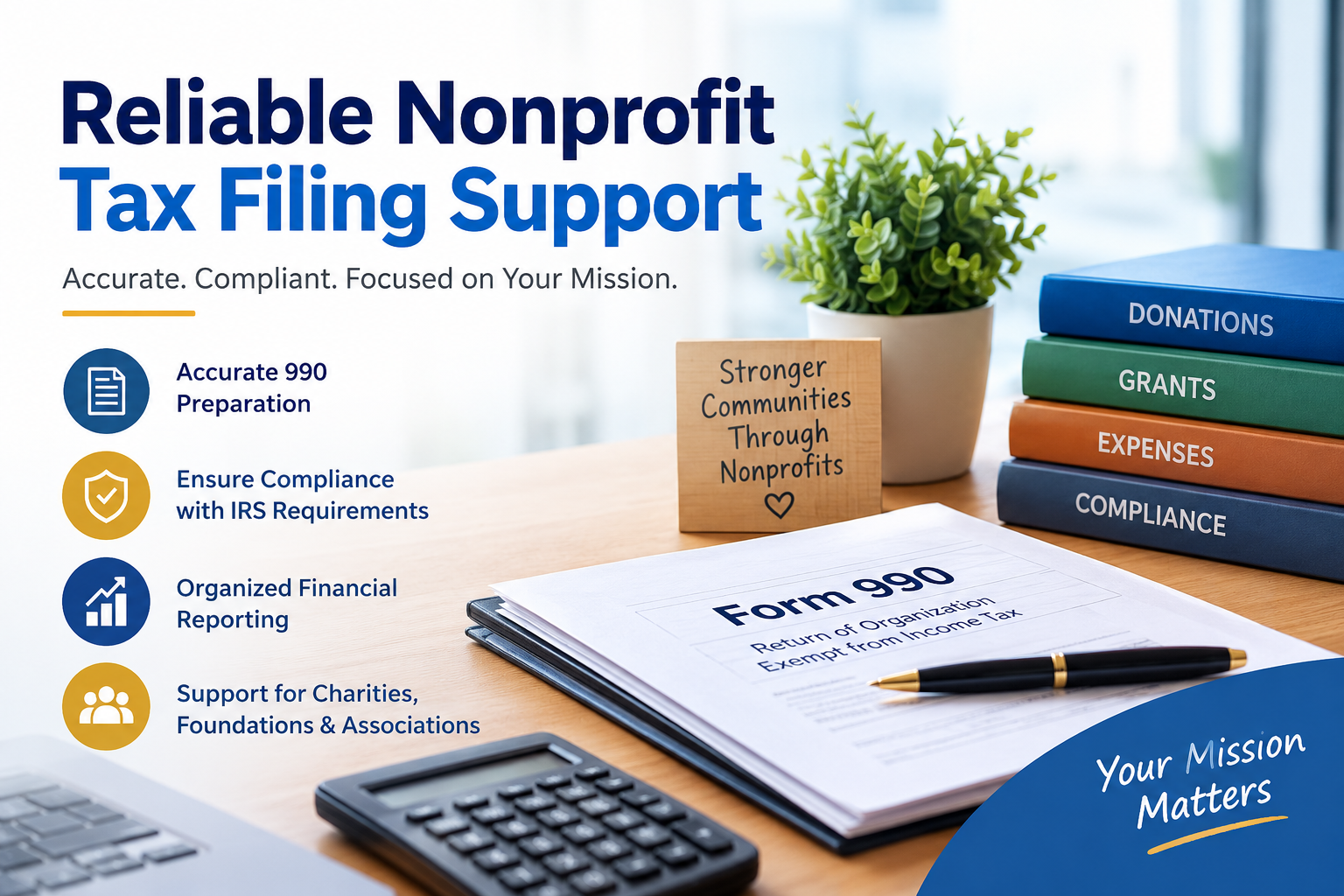
Nonprofit 990 Preparation Services for Tax-Exempt Organizations Finance & Wealth
Oct 15, 2026 • visibility 9 • 2 min read

Nonprofit 990 Preparation Services for Tax-Exempt Organizations

Nonprofit organizations must meet applicable IRS reporting requirements to maintain compliance and keep their financial records organized. Nonprofit 990 preparation helps eligible organizations prepare the appropriate forms based on their financial activities and filing obligations.Preparing Form 990, Form 990-EZ, Form 990-N, or Form 990-PF requires accurate financial information and proper documentation. Depending on the organization's eligibility, these forms report details about donations, grants, expenses, assets, and other financial activities.Professional nonprofit tax preparation support can help organizations organize financial records, review reporting requirements, and prepare the necessary documentation. Maintaining accurate accounting records and monitoring filing deadlines can also help reduce common filing errors.Cube Accounting Solutions offers tax preparation services for nonprofit organizations, individuals, and businesses, including nonprofit 990 preparation, individual tax returns, corporate tax returns, partnership K-1 preparation, and small business tax packages.Organizations should identify the appropriate filing form and verify their annual reporting obligations before submitting a return. With proper preparation and organized documentation, nonprofits can manage their tax filing responsibilities more efficiently.

cubeaccouting
Read arrow_forward
Vessel Management Services in Dubai for Safe, Efficient and Compliant Fleet Operations Finance & Wealth
Oct 13, 2026 • visibility 12 • 2 min read

Vessel Management Services in Dubai for Safe, Efficient and Compliant Fleet Operations

Nautilus Shipping provides vessel management services in Dubai focused on safe, efficient and reliable fleet operations. Our technical ship management approach covers planned maintenance, repairs, safety and environmental compliance, procurement, and performance monitoring. We work across vessel types with tailored solutions designed around each ship’s operational requirements. Our maritime professionals use proactive planning, real-time performance insights and structured compliance management to minimise downtime, control operating costs and support vessel longevity. From routine maintenance to long-term operational planning, we help shipowners maintain high standards of safety, performance and regulatory compliance. With a focus on operational efficiency and responsive problem-solving, Nautilus Shipping delivers dependable vessel management solutions for today’s global maritime industry.

Understanding UAE’s E-Invoicing Framework and Preparing for Digital Invoice Compliance Finance & Wealth
Oct 13, 2026 • visibility 13 • 2 min read

Understanding UAE’s E-Invoicing Framework and Preparing for Digital Invoice Compliance

The UAE’s e-invoicing framework introduces new requirements for how businesses generate, exchange and manage electronic invoices. Organizations preparing for the transition need to consider more than simply replacing paper or PDF invoices. Existing ERP, accounting and finance systems may need to support new invoice formats, validation processes and data exchange requirements. Businesses should also consider how invoice records will be maintained and how their systems can adapt as implementation progresses. An integrated e-invoicing approach can help reduce manual processing while supporting compliance and operational continuity. Preparing systems and workflows in advance gives organizations more time to identify gaps and make necessary adjustments before requirements take effect.

article
Finance & Wealth
Oct 13, 2026 • visibility 14 • 1 min read

Beyond Investments: How Financial Experts in Gurgaon Help You Build a Stronger Financial Future

Discover how financial experts in Gurgaon can help individuals and business owners make informed financial decisions beyond investments. This article explores personalized wealth management, portfolio diversification, risk management, and long-term financial planning. Learn how BellWether Associates’ “Your Personal CFO” approach and wealth management services can help clients organize their finances, protect their wealth, and plan for future financial goals.

Bellwether Associates
Read arrow_forward
article
Finance & Wealth
Oct 12, 2026 • visibility 10 • 26 min read

Stock Market Course in Mumbai — Share Market Classes at Upside

Are you looking for a stock market course in Mumbai to understand investing, trading, technical analysis, and the Indian financial markets? Whether you are a complete beginner, a working professional, a college student, or someone who wants to develop financial market knowledge, choosing the right training program is an important first step.Upside offers stock market education for learners who want to build their understanding of the share market through structured learning and practical market concepts. With a focus on developing market knowledge, analytical skills, and disciplined decision-making, Upside aims to help students understand how the stock market works and how to approach it responsibly.If you are searching for share market classes in Mumbai, this guide explains the learning opportunities at Upside, the topics you can explore, the importance of practical training, and how to choose a course that matches your goals.Explore the stock market courses offered by Upside to discover available programs and identify the right learning path for your objectives.Why Choose Upside for a Stock Market Course in Mumbai?Learning the stock market involves more than understanding when to buy or sell a stock. It requires knowledge of market fundamentals, price movements, risk management, trading psychology, and financial decision-making.Upside focuses on helping learners develop a foundation in these areas through structured stock market education.Structured Learning for BeginnersIf you are new to the share market, financial terminology and trading concepts can initially seem complicated. Understanding market indices, stock exchanges, demat accounts, order types, and price charts is essential before moving towards advanced concepts.A structured learning approach helps you understand these topics progressively, allowing you to develop your knowledge before exploring more complex market strategies.Browse the courses available at Upside to explore the current learning options and review their respective syllabuses.Practical Understanding of the Stock MarketPractical learning helps students connect theoretical concepts with market behaviour. Studying charts, understanding price trends, identifying support and resistance, and learning how trading decisions are evaluated can help make financial market concepts easier to understand.At Upside, prospective students can explore the available practical training components and course structure to identify the program most suitable for their learning objectives.Learning Technical and Fundamental AnalysisTechnical and fundamental analysis are two important approaches used to study securities.Technical analysis focuses on price movements, chart patterns, trends, and indicators. Fundamental analysis examines factors such as company performance, financial statements, business models, and valuation.If you want to learn chart analysis in greater detail, explore Upside's Technical Analysis Course.Understanding these approaches can help learners develop a more informed perspective on market movements and investment decisions.Developing a Disciplined ApproachSuccessful financial decision-making requires more than identifying opportunities. It also involves managing risk, controlling emotions, understanding uncertainty, and avoiding impulsive decisions.Stock market education should therefore include an understanding of trading psychology, risk-reward relationships, and the limitations of trading strategies.Stock Market Courses at UpsideThe right stock market course depends on your current knowledge, interests, and long-term objectives. Upside's available programs can be explored according to the subjects covered, duration, learning format, and level of instruction.Visit the Upside course directory to review the current programs and confirm which subjects are covered in each course.1. Stock Market Basics for BeginnersA beginner-oriented learning path introduces the basic concepts required to understand the Indian stock market.Topics may include:Introduction to the Indian stock market.Understanding the National Stock Exchange (NSE) and Bombay Stock Exchange (BSE).Equity shares and stock market indices.Demat and trading accounts.Market orders, limit orders, and order execution.Introduction to investing and trading.Basic market terminology and financial concepts.These fundamentals help students develop the knowledge needed to understand more advanced subjects.Before enrolling, review the relevant Upside stock market course options and confirm which program is most appropriate for beginners.2. Technical AnalysisTechnical analysis is used to study historical prices and trading activity to understand market trends and potential trading setups.Important topics include:Candlestick charts and chart interpretation.Support and resistance levels.Trend identification.Chart patterns.Technical indicators.Volume analysis.Entry and exit planning.Stop-loss concepts and risk-reward ratios.Learning these concepts can help students understand how traders analyse price behaviour. However, technical analysis cannot predict market movements with certainty or guarantee profitable trades.Learn more about the Technical Analysis Course at Upside to review the available training information.3. Fundamental AnalysisFundamental analysis focuses on evaluating a company's financial condition, performance, and business prospects.Relevant subjects include:Understanding financial statements.Revenue, profit, and earnings.Balance sheets and cash flow.Financial ratios.Business performance and valuation.Industry analysis.Long-term investing principles.This knowledge can help learners understand how financial and business information contributes to investment research.Explore the courses available at Upside to determine which program best matches your interest in company analysis and investing.4. Futures and OptionsFutures and options are derivatives whose values depend on underlying assets. These instruments involve additional complexity and can expose traders to substantial losses.Learners exploring derivatives should understand:Futures and options fundamentals.Call and put options.Strike prices and expiry dates.Option premiums.Intrinsic and time value.Basic options strategies.Margin requirements and leverage.Risk management in derivatives trading.Students should confirm which derivatives topics are included in their selected Upside program. A strong understanding of the underlying risks is essential before considering real-money derivatives trading.For current program options, refer to the Upside course directory.What Will You Learn in Share Market Classes at Upside?The purpose of stock market classes is to help learners understand financial markets through a structured educational process.Depending on the selected program, students should review whether the curriculum covers the following areas.Understanding How the Stock Market WorksStudents learn how shares are traded, how exchanges operate, how prices change, and how buyers and sellers participate in financial markets.This foundation helps make more advanced financial concepts easier to understand.Reading and Interpreting Stock ChartsCharts provide a visual representation of price movements over time. Learning to read candlesticks, identify trends, and understand support and resistance can help students interpret market behaviour.Chart-reading exercises can also help learners develop a systematic approach to analysing price data.Understanding Risk ManagementRisk management is one of the most important aspects of market education.Students should understand how position sizing, stop-loss orders, leverage, transaction costs, and risk-reward relationships affect trading outcomes.A trading strategy can incur losses even when it appears promising. Therefore, understanding risk is as important as understanding potential returns.Developing Trading PsychologyMarket fluctuations can trigger fear, excitement, and impulsive decisions. Trading psychology examines how emotions and behaviour influence financial choices.A disciplined approach includes following a defined plan, evaluating decisions objectively, and avoiding the assumption that every market opportunity will be profitable.Building Independent Analytical SkillsThe objective of learning should be to develop the ability to evaluate information rather than blindly follow tips or recommendations.Understanding market concepts, researching companies, interpreting charts, and reviewing trading decisions can help learners develop a more independent approach to financial markets.Practical Stock Market Training at UpsidePractical exercises can help learners connect classroom concepts with real-world market behaviour.For example, a learning exercise may involve studying a historical stock chart, identifying support and resistance levels, documenting a potential setup, and explaining the reasoning behind a hypothetical entry and exit.Students can also benefit from reviewing trading journals, evaluating hypothetical risk-reward scenarios, and analysing why a trading decision may or may not have worked.These activities help develop analytical thinking and encourage learners to approach the market systematically.Before enrolling, prospective students should ask Upside about the practical components included in their chosen course, such as assignments, demonstrations, practice sessions, and instructor feedback.To find a suitable program, visit the Upside stock market courses page.Who Can Join Stock Market Classes at Upside?Stock market education can be useful for people with different interests and experience levels.College StudentsStudents interested in finance, economics, investment research, or financial markets can use structured learning to build foundational knowledge.Working ProfessionalsProfessionals who want to understand investing and financial markets can explore courses that fit their existing knowledge and available study time.Beginners Interested in InvestingPeople who want to understand stocks, company performance, and long-term investing principles can start by learning the basics before making investment decisions.Aspiring TradersLearners interested in trading can explore technical analysis, trading strategies, market structure, and risk management while understanding that trading outcomes are uncertain.Individuals Interested in Finance CareersPeople exploring financial services careers may benefit from studying financial markets and developing analytical skills. Specific roles can require additional qualifications, examinations, experience, or regulatory approvals.The appropriate Upside program will depend on your individual learning objectives and the curriculum currently available.Explore the available Upside courses to find a learning path that aligns with your goals.How to Choose the Right Stock Market Course at UpsideBefore enrolling in a stock market course, consider the following factors.1. Define your objective. Decide whether you want to understand long-term investing, learn technical analysis, explore derivatives, or develop knowledge for a finance career.2. Check the syllabus. Review the modules and confirm that they cover the subjects you want to learn.3. Understand the course duration. Consider the scheduled teaching hours, opportunities for revision, and time needed for independent practice.4. Ask about practical training. Find out whether the program includes chart analysis, assignments, demonstrations, or practice exercises.5. Review the fees. Confirm the current tuition fee, applicable taxes, payment options, and any additional charges before enrolling.For a more detailed overview of course pricing, read Upside's guide to stock market course fees in Mumbai.6. Understand certification. Check whether the course provides an institute-issued completion certificate or prepares students for a separate external examination. These are not necessarily equivalent.7. Clarify student support. Ask about doubt-solving sessions, missed classes, revision opportunities, and any support available after course completion.Taking these steps can help you select an appropriate learning program and set realistic expectations.Stock Market Course Fees in MumbaiThe cost of a stock market course depends on factors such as the course level, duration, subjects covered, practical components, and learning format.At Upside, prospective students should check the latest fee details for the specific program they wish to pursue.Before confirming admission, ask for a clear breakdown of the total course cost, including applicable taxes, study materials, examination charges where relevant, and any additional fees.For more information about pricing, inclusions, and budgeting, visit the Upside stock market course fees guide for Mumbai.Understanding the complete cost upfront makes it easier to plan your learning journey and avoid unexpected expenses.For current course options and pricing, visit the Upside website or contact the institute directly.Career Opportunities After Learning the Stock MarketStock market education can help learners build knowledge relevant to financial markets, investment research, and trading-related activities. However, completing a course does not automatically qualify someone for every financial services role.Depending on their skills, qualifications, experience, and applicable requirements, learners may explore areas such as:Equity research support.Financial market analysis.Investment operations.Trading support.Financial content and market research.Personal investing and portfolio research.Some positions require additional professional qualifications or regulatory certification. Students interested in a finance career should identify the requirements for their intended role before selecting a course.It is also important to distinguish career preparation from trading with personal capital. Learning market concepts does not guarantee employment, income, or profitable trading results.Review the Upside course directory to identify programs relevant to your learning objectives.Why Risk Management Matters in Stock Market EducationAn important part of learning the stock market is understanding that financial markets involve uncertainty.Prices can move against expectations, and losses may occur even when a trader follows a defined strategy. Leverage and derivatives can increase the scale of potential losses.A responsible learning process should emphasise:Understanding the risk before entering a trade.Using appropriate position sizing.Learning how stop-loss orders work and their limitations.Evaluating the impact of transaction costs.Avoiding excessive leverage.Maintaining realistic expectations.Practising and reviewing decisions before risking significant capital.At Upside, students should explore how these topics are addressed within the syllabus of their selected course.The goal of financial education is to improve knowledge and decision-making, not to promise guaranteed profits.Frequently Asked Questions About Upside Stock Market Courses1. Is Upside suitable for beginners who have no stock market knowledge?Beginners can start by learning the basic concepts of the stock market, including exchanges, shares, demat accounts, order types, and market terminology. Prospective students should review the Upside course directory to identify the program designed for their experience level.2. Which stock market course should I choose at Upside?The right course depends on your objective. Someone interested in long-term investing may need a different learning path from someone interested in technical analysis or derivatives. Review the available Upside programs and compare their subjects, duration, and intended outcomes before enrolling.3. What topics are covered in stock market classes?Depending on the program, subjects may include stock market fundamentals, technical analysis, fundamental analysis, chart interpretation, trading concepts, derivatives, and risk management. Refer to the Upside course directory for the confirmed modules included in each course.4. How much does a stock market course at Upside cost?Course fees depend on the selected program and its inclusions. Read the stock market course fees guide for Mumbai and contact Upside for accurate pricing, payment terms, taxes, and any additional charges.5. Can I learn the stock market while working or studying?This depends on the course timetable and the time available for independent study. Ask Upside about current batch schedules, class timings, and available learning formats through the official contact page.6. Does Upside provide practical stock market training?Review the practical components of your preferred program with the Upside team. Ask about chart-reading exercises, assignments, demonstrations, practice sessions, and feedback opportunities so that you understand how the training is delivered.Explore the Upside stock market courses to review available programs.7. Does completing a stock market course guarantee profits?No. No educational course can guarantee trading profits. Market outcomes are uncertain, and all investment and trading decisions involve risk. Education can help build knowledge and analytical skills, but it cannot eliminate market risk.8. Will I receive a certificate after completing a stock market course?Certificate availability and eligibility depend on the specific program. Confirm with Upside whether the course offers an institute-issued completion certificate or includes preparation for an external certification examination.You can enquire through the Upside contact page.9. Can a stock market course help me pursue a finance career?A course may help develop relevant foundational knowledge, but career eligibility depends on the role, the employer's requirements, your qualifications, and any applicable regulatory conditions. Check the syllabus and career-related support available through your selected Upside program.10. How can I enrol in a stock market course at Upside?Visit the Upside share market classes in Mumbai page, review the available course information, and contact the institute to confirm the syllabus, schedule, fees, admission requirements, and next steps.Start Your Stock Market Learning Journey with UpsideBuilding a strong understanding of the stock market starts with the right learning foundation. From market fundamentals and chart interpretation to analytical thinking and risk management, structured financial education can help you approach the markets with greater knowledge and discipline.If you are searching for a stock market course in Mumbai or share market classes in Mumbai, explore the programs available at Upside and identify the one that aligns with your goals.Explore stock market courses at Upside.Review the stock market course fees guide.Learn about the Technical Analysis Course.Contact Upside for current batch schedules, fees, and admission information.Ready to get started? Visit Upside's share market classes in Mumbai page to explore your learning options.Learn the concepts, develop your analytical skills, and build a more informed approach to understanding the Indian stock market.